Posts

Herdmania : Retrogressive Metamorphosis , Characteristics | Biology Blog
Image
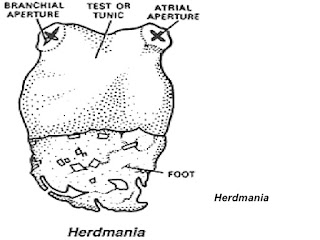
                         Metamorphosis In Herdmania Metamorphosis is the biological process in which an organism starts to develops physically after birth or hatching. During the development, the organism's body starts to develop inits original or mature form, and the habit also starts to develop. There are numerous examples of metamorphosis Like tadpole that grows and changes into  Adult Frog. The young of such are called larvae.  The juvenile swimming larva that Herdmania gives birth to has characteristics like the notochord, dorsal neural tube, and specific sensory organs. After metamorphosing, this swimming larva becomes an adult, and distinctive traits change along with it. The adult one has characteristics like a pharynx with stigmata and an endostyle, which reveal that it is a chordate. Retrogressive metamorphosis is the name given to this type of metamorphosis, which exhibits deterioration from larva to...

Spindle Fibre Formation and their organisation

Image
                                                                                                                                               Spindle Fibre  What is the Spindle Apparatus - Spindle apparatus also called spindle fiber is the structure that's separate the chromosomes into daughter cells during cell division. Depending upon the type of cell division , it is also referred to as mitotic spindle during mitosis and meiotic spindle during meiosis.  Shape and Formation -  The cellular spindle apparatus includes the spindle microtubules, associated proteins, and any aster present at the spindle poles. The sp...

Sycon Canal System With Diagram

Image
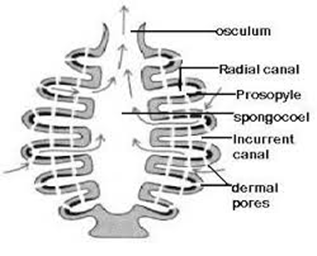
                                     Canal system in Sycon  A sea creature called a sycon, or scypha , is usually found clinging to rocks or other surfaces. These creatures have tube-shaped bodies that open outward with the help of a hole called an Osculum . They have tiny openings called Spiracles and Ostia all over their bodies to let water in. This water flows through canals inside their bodies and comes out through the Osculum, which is a larger opening used for breathing. We'll observe the shape of this canal system, why it is essential for those animals, type of canal system , and  its significance. The Sycon Type Canal system is the unique feature of the phylum Porifera . This system is also known as the  aquiferous canal system . This system supports the significant function of the body like nutrition, respiration, excretion, etc. History Overview -  Gran...

Difference between Prokaryotic & Eukaryotic cells | Biology Blog

Image
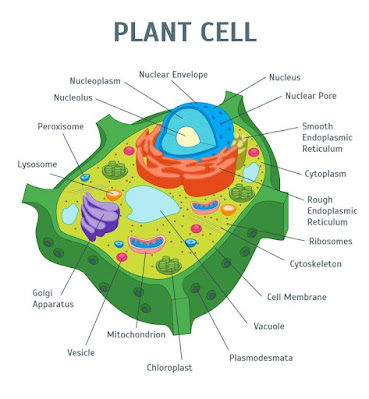
        Difference Between prokaryotic and eukaryotic cells The fundamental unit of life is the cell. Cells make up every living thing on the planet, including the plants and bacteria. The nucleus, which is situated in the core of every cell and is in charge of further cell division, is there. Prokaryotic cells and eukaryotic cells are the two different types of cells based on the nucleus' structure. Prokaryotic cells are said to have initially arisen, and through organic evolution, they eventually transformed into eukaryotic cells. Prokaryotic cells -  It is a basic form of cell. Prokaryotes are commonly seen blue-green bacteria. Their intracellular membrane is absent. Its genetic material (DNA) is dispersed throughout the cytoplasm and their nucleus is not encircled by a nuclear membrane. Prokaryotic cells lack cell organelles including the endoplasmic reticulum, mitochondria, and Golgi bodies, among others. Check-in depths - Golgi body , chloroplast ...

Kreb Cycle Steps With Diagram , Steps & Products

Image
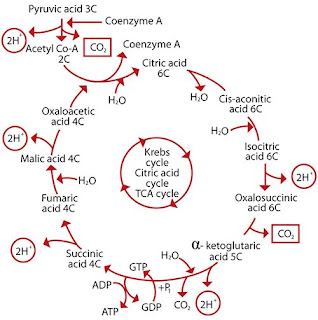
                                            Kreb Cycle  Krebs cycle is also known as the citric acid cycle or tricarboxylic acid cycle(TCA) . It was discovered by H.A.Kreb in 1953. Kreb Cycle cycle occurs in the matrix of the mitochondria . The whole cycle of Kreb is described in the following figure. The net result of the Krebs cycle is that acetyl group entering the cycle as acetyl- CoA, two molecules of carbon dioxide are produced.  Kreb Cycle Steps - Condensation - Acetyl CoA combines with oxaloacetic acid in the presence of citrate synthetase enzyme to form citric acid. It is the first product of the Krebs cycle. Dehydration -  Citric acid in presence of aconitase enzyme is converted into cis-aconitic acid. Water is released here. Hydration - Cis-aconitic acid is converted into isocitric acid with the addition of water in the presence of...

what do you know about virus - Biology Blog

Image
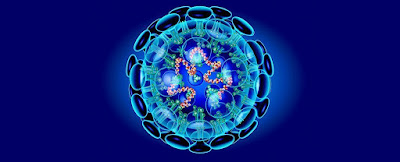
                                              Virus  Viruses are simple noncellular entities consisting of one or more molecules of either DNA or RNA enclosed in a coat of protein. They become active only in living cells and they are intracellular parasites. The size of the virus is 0.02 to 0.03 micrometer but the size of the virus in smallpox is 200nm in diameter which is the largest size of the virus.  A fully assembled infectious virus is called a virion . " The main function of the virion is to deliver its genetic material into the host cells so that the genome can be expressed by the host cell. " Viral Structure - The structure of virions is very diverse, varying widely in size, shape, and chemical composition.  All viruses have a nucleocapsid composed of nucleic acid surrounded by a protein capsid. The capsid is formed as single or doub...

Explain principle of electron microscopy : Biology Blog

Image
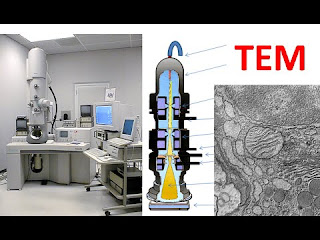
                              Principle of  electron microscopy Around 1931-32, two German scientists, Knoll and Ruska invented transmission electron microscopy and developed a transmission the electron microscope (TEM) around 1940. Principle - A strong beam of electrons discharged from tungsten filaments after supplying them with high voltage electronic current, pass through a vacuum and refocussed electromagnets. Radiation (wavelength 0.05 angstrom) is produced from it which is utilized as a source of illumination to the objects. An image is formed when electrons strike on a fluorescent screen or on a photographic film. Several hundred thousand times magnifications and resolution of about 5 angstroms can be achieved by TEM.  The compound of a transmission electron microscope - Electrogun - it is located on the top of the microscope. It works as a  source of electrons. It con...