Posts

Showing posts with the label Biology

How Neurons Are Formed : Biology Blog

Image
                                    Structure Of Neuron All animals have a very important functional neural system in their body which is comprised of highly specialized cells called Neurons which can detect, receive and transmit different kinds of stimuli. Every neuron is made up of a cell body and cell process (Dendron and axon ).                                                    Cell Body or Cyton -   It contains uninucleated cytoplasm. Except for centriole, all cell organelles are found in the cytoplasm . The centriole is absent in the nerve cell thus cell division is absent . Nissl's granules - Endoplasmic Reticulum and ribosomes form granules like structures called Nissl's Granules. Cell Process -   Dendron - The fine bra...

The Process of Megasporangenesis in Angiosperms : Biology Blog

                                        Megasprogenesis  The formation of megaspore mother cells from megaspore mother cells is called megasporogenesis.  This process occurs inside the nucellus of developing ovule of angiosperms. It is surrounded by a layer known as the epidermis . Below the epidermis, there is a layer known as hypodermis. One cell of hypodermic divide and grow in a bigger size which is known as archesporial cells.                                        These archesporial cells divide periclinal to form an outer parietal layer and inner sporogenous cells. These sporogenous cells function as megaspore mother cells (MMC). These cells divide meiotically and form four haploid tetrad cells. Out of which three degenerate and only one remain is functional. On...

Overview On Phylum Chordate - Biology Blog

Image
                                       Phylum Chordata dorsal, hollow nerve cord – becomes the brain   spinal cord notochord   - flexible, fibrous rod along the back (replaced by vertebrae in advanced vertebrates) pharyngeal gill slits - openings in the throat region. postanal tail – most other animals with tails near the anus have anus at end of the tail. T hese features may each be lost or altered in the adult. This phylum has three subphyla: 1. Cephalochordata, 2. Urochordata, and 3. Vertebrata 1. Subphylum Cephalochordata (clade) – lancelets fishlike creatures that bury selves in mud and filter feed all four key chordate feature present in adults like vertebrates, muscles broken up into bands called myomeres (body segmentation) essentially no brain in adults Ex.- Urochordata – Ascidia, Salpa, 2. Subphylum Urochordata...

Bruce Ames Contribution In Oncology

Image
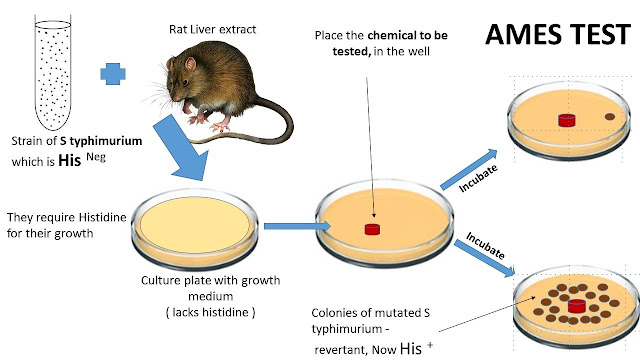
                                                                                                       Ames Test  Bruce Ames develops a method to  test the chemicals for cancer causing properties .  The test is based on the fact that  any thing that is mutagenic may also turn out to be a carcinogen, that is to cause cancer . The assay is based on the reversion of the mutation in the histidine operon in the genetically altered tester strains of bacterium Salmonella typhimurium . The his peron encodes enzymes required for the biosynthesis of the amino acid hitsidine . Strains with mutations in the his operon are histidine auxotrophs . However , the mutation can be reversed , a back mutation , with the gene...

Gram Positive , Gram Negative Bacteria With Staining method

Image
                     Gram-Positive Bacteria & Gram-Negative   Bacteria have a cell wall made up of polysaccharides known as Peptidoglycans which gave them strength and rigidity and this is important since bacteria observe some osmotic pressure due to the variation of different solutions they encounter and their cell wall which prevents the cell from shrinking or swelling. So , on the basis of the cell wall and the pattern of gram staining, bacteria are classified into two categories - Gram-Positive and Gram-Negative. Gram-positive bacteria  have double-thick walls which consist of around 30 layers of peptidoglycan and surrounds a single plasma membrane.  They do not have an outer cell membrane but have a complex cell wall made up of teichoic acid.  For example - Staphylococci.   Gram-negative bacteria  have a much thinner cell wall consisting of peptidoglycans having high lipid content...

Biology 12th class Question Bank : Part 4

Image
                                         Sheet -4  Draw a well labelled diagram of  male reproductive system . Write a short note on Algal Bloom . Write a case study of plastic waste by Ahmed Khan , Bangalore . Light on Ramesh Chandra Dagar case . Write a short note on Parturition . Explain sex determination in honey bee . Write difference between Hemophilia and sickle cell anemia . Explain the artificial method of insulin production . Write about the strategy  used for pest resistance plants through RNA interference Write the full form of IVF . Write the difference between active immunity and passive immunity .  Draw a well labelled diagram of Antibody . Write a note on microbes used in bio gas plant . Explain Miller Experiment . Draw a well labelled diagram of female reproductive system . 

Carbohydrates Classification , Structure , Sources With Example

Image
                                         Carbohydrate         Carbohydrate is one of the main biomolecules present in our body in the form of sugar ( glucose ), starch & fiber.  Besides providing energy to all over the body, carbohydrates play a significant role in many cellular activities. Carbohydrates are simply the combination of carbon, hydrogen, oxygen. They are also known as " the derivatives of aldehyde and ketone ." The general formula of carbohydrates is CN(H 2 O)N . In biochemistry the word carbohydrate is known by another name - Saccharide means sugar molecules. On the basis of the composition of sugar, molecules carbohydrate is divided into the following parts - 1. Monosaccharides - Here the word Mono means single& saccharide means sugar molecules & hence the term Monosaccharides. Monosaccharides are the molecu...

Biology and characteristics of living things : Biology Blog

                               Characteristics of living beings Welcome to this blog where we will explore the fascinating world of living beings and delve into the realm of Biology. To begin with, let's understand the term " Biology ." The word can be broken down into two parts - "Bio," which refers to life or living organisms, and "logy," which denotes the study of a particular subject. Therefore, Biology is the scientific study of living organisms, encompassing their physiology, anatomy, and distinctive features. Living organisms possess certain characteristics that set them apart from non-living entities. These defining traits include: Growth : Living organisms have the ability to grow internally. Unlike non-living objects that may grow externally, such as mountains with the accumulation of flora, living beings undergo internal growth and development. Reproduction : Reproduction is a vital process for th...